A very well-preserved and highly attractive U.S. Springfield Armory Model 1903 chambered in .30-06 Springfield, displaying a remarkably cohesive configuration with strong World War I-era characteristics throughout.
The receiver, serial number 663***, was manufactured by Springfield Armory and falls within the documented 1917 production range. The barrel was also manufactured by Springfield Armory and is clearly marked “SA / Flaming Bomb / 1-18,” indicating production in January 1918.
1917 Receiver / SA 1-18 Barrel
The combination of a 1917 Springfield receiver and January 1918 Springfield Armory barrel is consistent with known Springfield Armory WWI production practices and surviving examples.
M1903 receiver serial numbers do not necessarily correspond directly to the date on which a complete rifle was finally assembled. Surviving-rifle studies indicate that numbered receivers were not necessarily assembled into completed rifles in strict numerical sequence, making it inappropriate to determine an exact completion date solely from the receiver serial number.
Importantly, surviving M1903 serial and barrel records include documented examples of Springfield receivers within the 1917 production range fitted with SA 1-18 barrels. This establishes the 1917 receiver / January 1918 SA barrel combination as a historically compatible WWI-period pairing represented among surviving rifles.
Without original ordnance documentation specific to this individual rifle, however, it is impossible to conclusively determine whether this particular SA 1-18 barrel was installed during the rifle’s initial assembly or during its early service life.
The most appropriate assessment is therefore that the SA 1-18 barrel is fully consistent with the rifle’s WWI service period and may represent either its original barrel or an early period replacement, rather than an obviously later barrel associated with a WWII or postwar rebuild.
Correct WWI Two-Bolt Grasping-Groove Stock
One of the rifle’s most desirable early features is its straight-grip, two-bolt grasping-groove stock.
The straight stock with grasping grooves is one of the characteristic features of early M1903 production, while the two-bolt reinforced configuration is entirely appropriate for a 1917-production Springfield M1903.
Of particular interest is a closely related documented surviving example:
Springfield M1903 serial no. 664507
This rifle is a documented USS California M1903. Published examination records specifically describe its stock as the early “finger grasping groove” pattern with two reinforcing stock screws.
Serial no. 664507 is only approximately 1,000 numbers removed from the present rifle’s 663*** serial number, providing an unusually close documented comparison supporting the correctness of the two-bolt grasping-groove stock configuration within this particular receiver serial range.
Naturally, this comparison supports the period correctness of the stock pattern; it does not by itself establish that the individual stock presently fitted to this rifle is unquestionably the exact stock installed when the rifle was originally assembled.
Overall Parts & Configuration
Beyond the receiver, barrel and correct early stock configuration, multiple Springfield Armory manufacturing marks and period-correct production/inspection markings are visible throughout the rifle.
The visible components are generally consistent with an early M1903 configuration. No obvious later Remington “R”-marked components are present, nor is there an obvious mixture of substantially later replacement parts.
The early precision-adjustable rear sight, milled steel furniture, checkered steel trapdoor buttplate and other visible components are consistent with the rifle’s WWI-era configuration and display a notably cohesive pattern of age and wear.
Taken together, there is no obvious visual evidence of a typical later comprehensive arsenal rebuild or extensive reconfiguration.
Metal Finish
The metalwork remains in very good overall condition and appears to retain a substantial amount of its early blued finish, accompanied by an attractive and naturally developed century-old patina.
The receiver, barrel and principal metal components show notably consistent coloration, wear and aging, without the conspicuous differences often encountered on rifles assembled from components refinished or replaced at substantially different periods.
None of the visible components exhibit the more obvious gray or gray-green Parkerized appearance often encountered on later arsenal-refinished M1903 rifles, helping the rifle retain a particularly cohesive early appearance.
SA 1-18 Barrel & Bore
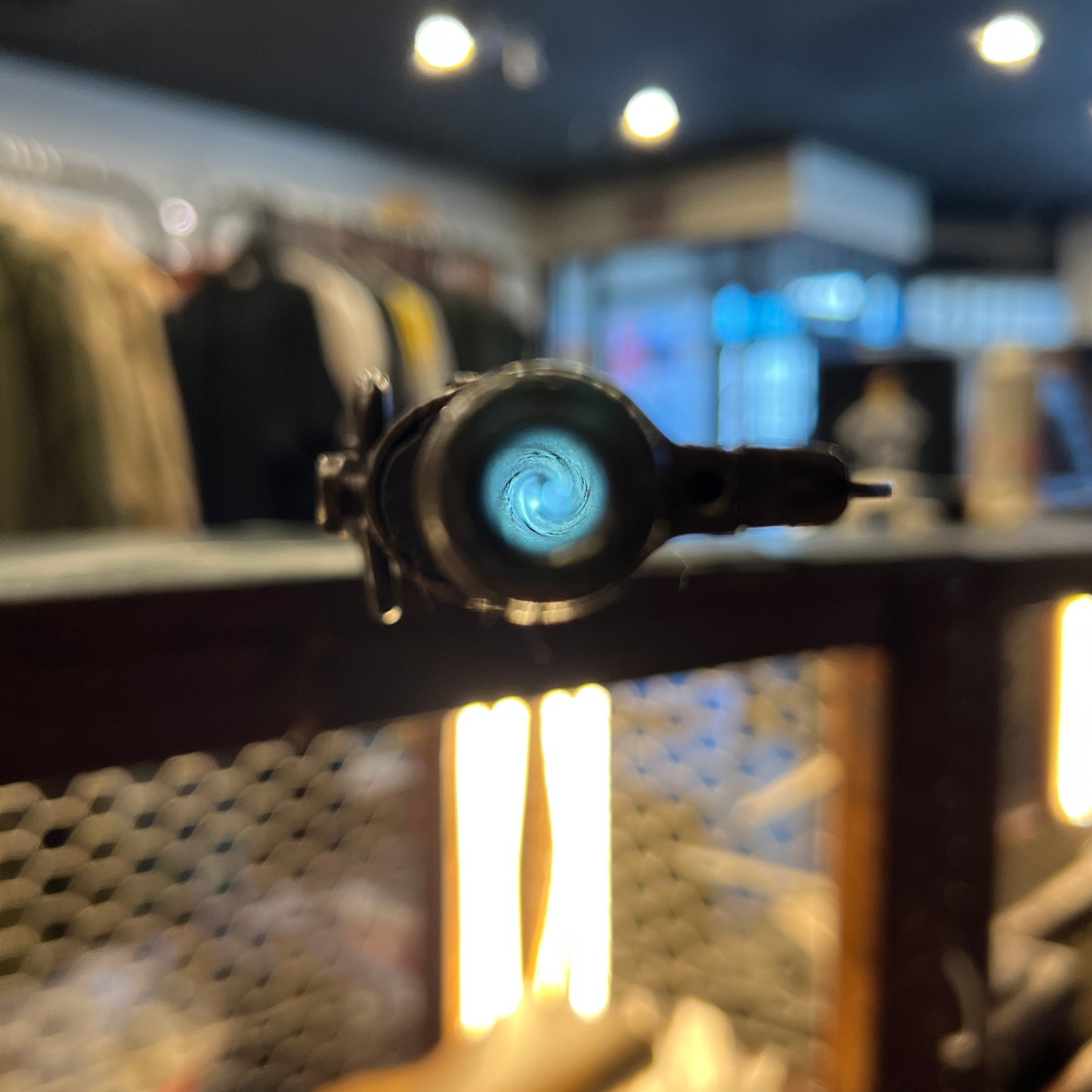
The January 1918 Springfield Armory barrel retains a relatively bright bore with strong, clearly defined rifling, showing only the expected age-related wear associated with a military rifle of this period.
Considering that the barrel is now more than a century old, the bore remains in very respectable condition and represents another particularly desirable feature of this example.
Stock & Handguard Condition
The early two-bolt grasping-groove stock is exceptionally clean overall while retaining appropriate service wear and natural age consistent with a century-old U.S. military rifle.
Springfield Armory-related markings and other period details remain present on the stock.
The upper handguard shows one small hairline crack that appears to have been repaired earlier in its life. The repair appears stable upon visual inspection and does not significantly detract from the rifle’s overall appearance or collector appeal.
Overall Assessment
Overall, this is a highly cohesive early Springfield Armory Model 1903 retaining numerous correct WWI-period features and displaying strong indications of period originality.
Of particular interest is the combination of its 1917 Springfield Armory receiver, January 1918 SA barrel, correct WWI-period two-bolt grasping-groove stock, period-correct Springfield/U.S. military components, and remarkably consistent early finish and wear.
Surviving documentation and comparable rifles also provide useful historical support for the present configuration: Springfield M1903 rifles within the 1917 receiver production range are documented with SA 1-18 barrels, while the closely numbered USS California M1903 serial no. 664507 is specifically documented with the same period two-bolt grasping-groove stock configuration.
These references cannot establish that every individual component on this rifle has remained untouched since its original assembly. However, when considered together with the rifle’s own period-consistent components, finish, wear patterns and absence of obvious later comprehensive rebuild characteristics, there is good reason to describe the rifle as retaining a:
Likely Original / Period-Original WWI Configuration.
Given that many early M1903 rifles were subsequently rebarreled, arsenal rebuilt, refinished or fitted with later replacement components during their exceptionally long service lives, an example retaining this degree of WWI-period consistency, correct early grasping-groove furniture and overall period character should be of particular interest to collectors of the Springfield M1903 and U.S. World War I military arms.