AAG CANADA
Exceptionally Scarce Chinese Shanxi Type 6-5(晋造六五) Rifle Stock Assembly – Chinese Walnut – Complete Furniture – Three-Star Marked
Exceptionally Scarce Chinese Shanxi Type 6-5(晋造六五) Rifle Stock Assembly – Chinese Walnut – Complete Furniture – Three-Star Marked
Couldn't load pickup availability
The Shanxi Type 6-5 rifle(晋造六五式), commonly referred to by collectors simply as the "Shanxi 6-5," represents one of the most historically significant indigenous military rifles produced in Republican China. Manufactured by the Taiyuan Arsenal system in Shanxi Province, the rifle was developed from the Japanese Type 38 Arisaka platform and chambered for the 6.5×50mmSR Arisaka cartridge, reflecting one of the earliest large-scale efforts by a Chinese arsenal to domestically manufacture a modern military service rifle.
Production of the Shanxi Type 6-5 rifle is generally estimated at approximately 108,000 to 112,000 examples. Despite this relatively substantial wartime production, surviving original rifles are regarded as exceptionally scarce today. According to long-standing collector research, approximately 44 documented examples were known as of 2009, with a limited number of additional specimens identified in the years since. As a result, some researchers and advanced collectors have suggested that fewer than 100 documented examples may currently be known worldwide. However, no comprehensive international census has ever been published, and this figure should be understood as an estimate of currently documented specimens, rather than a verified count of the rifle's actual surviving population.
Unlike the vast numbers of Japanese Type 38 rifles imported or captured during the first half of the twentieth century, original Shanxi-produced rifles saw extensive military service throughout the Warlord Era, the Northern Expedition, the Second Sino-Japanese War, and the subsequent Chinese Civil War. As a result, original rifles were frequently repaired, rebuilt, or cannibalized for parts. Wooden components were among the first parts to suffer damage or replacement, making surviving original-period stock assemblies considerably scarcer than their metal counterparts.
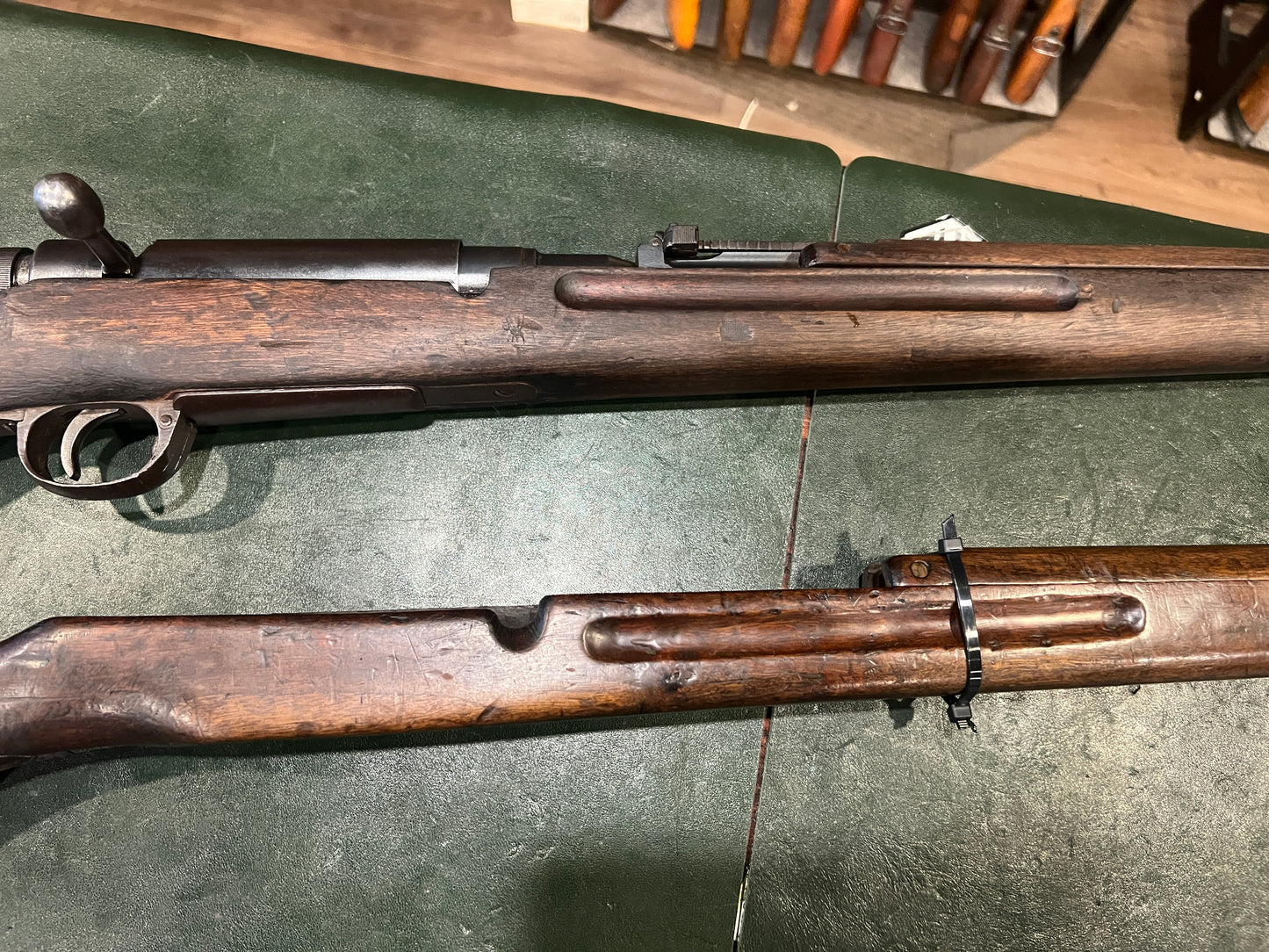
The final photograph compares the stock of this rifle (bottom) with that of a standard Japanese Type 38 Arisaka (top). The relative positions of the finger groove and drainage groove differ from those found on standard Japanese Type 38 stocks, reflecting one of the subtle manufacturing characteristics associated with original Shanxi Arsenal stocks. Although closely based on the Japanese Type 38 design, these distinctions illustrate the independent manufacturing practices employed by the Shanxi Arsenal during domestic production.
Included Components
This offering consists of a substantially complete period Shanxi Type 6-5 stock assembly, including:
- Main stock
- Upper handguard
- Steel buttplate
- Rear sling swivel
The principal wooden components remain together with their original furniture, making this an exceptionally desirable restoration or research piece.
Differences Between the Shanxi Type 6-5 Stock and the Japanese Type 38 Stock
Although based upon the Japanese Type 38 rifle, the Shanxi Type 6-5 stock exhibits several characteristics that distinguish it from standard Japanese production.
Japanese Type 38 rifles were manufactured using several native hardwood species depending upon production period and arsenal, with Japanese beech being among the most commonly encountered. Many original Japanese stocks also feature the characteristic factory butt splice, where the rear portion of the stock was joined using a separate section of wood in order to conserve high-quality timber.
By contrast, Shanxi-produced stocks are generally encountered with locally sourced Chinese hardwoods. Based upon the visible grain structure, open pore pattern, coloration, and long-term oxidation, the wood of this example displays macroscopic characteristics highly consistent with aged Chinese walnut-type hardwood. The grain is comparatively open and exhibits the natural variation commonly associated with Chinese-grown walnut, having developed a deep, rich patina through decades of military service, oil absorption, and natural aging.
Unlike the typical Japanese butt splice, this stock exhibits continuous grain through the butt section without the characteristic factory splice commonly observed on Type 38 stocks. While no laboratory wood identification has been performed, the visible characteristics closely correspond with those expected of original Shanxi-produced examples.
Original Manufacturing Characteristics
The stock has been thoroughly examined internally, including the receiver inlet, magazine well, action screw recesses, fore-end, and upper handguard.
No hidden assembly numbers were observed beneath the handguard, inside the receiver inlet, or within other concealed areas. This should not be considered unusual. Unlike the relatively standardized numbering practices employed by Japanese arsenals, surviving Republican Chinese production demonstrates considerable variation in assembly numbering, and numerous known period examples exhibit no concealed assembly numbers at all.
Internally, the stock retains numerous original hand-tool machining marks consistent with low-mechanization arsenal production. Tool marks remain visible throughout the receiver inlet and magazine well, while the interior surfaces exhibit uniform oxidation, accumulated age, oil staining, and natural wood aging throughout.
Importantly, no evidence of modern glass bedding, epoxy reinforcement, large-scale wood replacement, machine re-inletting, or recent reproduction work was observed during examination.
Taken as a whole, the construction, machining characteristics, and aging patterns are entirely consistent with a period Shanxi Type 6-5 stock assembly.
Condition
The overall condition remains remarkably complete considering nearly a century of military use.
The exterior retains honest military handling wear, scattered dents, abrasions, oil staining, and a naturally developed patina acquired through long-term service and storage. Several age-related cracks are present, particularly around the wrist and butt section, together with normal shrinkage associated with old military hardwood.
Importantly, the stock remains structurally complete, with no major losses of wood, no missing principal sections, and all primary components retained. The main stock, upper handguard, buttplate, and rear sling swivel remain present.
Rather than detracting from the piece, these honest service characteristics form an important part of its historical authenticity.
The Three-Star Marking
Perhaps the most intriguing feature of this stock is the presence of three carefully arranged five-pointed star markings located on the right side of the buttstock.
Each star exhibits nearly identical dimensions and proportions, displaying broad five-point geometry together with a distinctive circular center. The consistency of both layout and execution strongly suggests deliberate manufacture rather than later decorative carving.
In an effort to better understand these unusual markings, our shop consulted several advanced collectors specializing in Republican Chinese military firearms. Through their private collections, we were able to examine photographs of several exceptionally scarce Chinese-made military rifles, many of which are seldom encountered on the public market.
Of particular interest, a number of these rifles exhibit closely comparable five-pointed star markings on their receivers. The proportions of the stars, including the broad-point profile and distinctive central circular punch, closely resemble those found on this stock.
These surviving examples demonstrate that this style of five-pointed star was indeed employed on Republican-era Chinese military firearms and should not be dismissed as a random or later civilian addition.
However, an important distinction remains. Nearly all currently documented examples occur on metal receiver components, whereas this stock displays three consecutive stars impressed into the wooden buttstock. Because they appear on different materials, different components, and potentially served different manufacturing purposes, it cannot presently be concluded that they represent the same inspection, acceptance, or production marking.
Unfortunately, the destruction of large portions of Chinese arsenal documentation during the Second Sino-Japanese War and the subsequent Chinese Civil War has left very little surviving archival material capable of explaining these markings with certainty.
Accordingly, no definitive interpretation is offered here.
At present, the available evidence supports only that this distinctive star motif formed part of the broader marking system employed on at least some Republican Chinese military firearms. Whether these stars relate to factory inspection, production stages, assembly procedures, repair work, or another internal arsenal practice remains an open question awaiting future archival discoveries and comparison with additional surviving examples.
Collector Significance
The Shanxi Type 6-5 rifle occupies an important place in the history of Chinese military arms. Original wooden furniture is among the rarest surviving components, having frequently been damaged, replaced, or discarded during decades of military service and subsequent rebuilding.
Complete original-period stock assemblies seldom appear on the collector market. Examples retaining the main stock, upper handguard, buttplate, rear sling swivel, original internal machining characteristics, and such unusual research-worthy markings are exceptionally difficult to obtain.
Whether acquired as the correct restoration component for a Shanxi Type 6-5 rifle or preserved as an independent artifact representing Republican China's military industrial history, this stock assembly constitutes an increasingly scarce and historically significant collector's piece.
Share