AAG CANADA
Rare BSA Commercial Lee-Metford “Long Lee” .303 British – 7-Groove Metford Rifling – G. Fulton Marked
Rare BSA Commercial Lee-Metford “Long Lee” .303 British – 7-Groove Metford Rifling – G. Fulton Marked
Couldn't load pickup availability
Offered here is an exceptionally interesting early British Birmingham Small Arms Co. (BSA) commercial Long Lee target/service-pattern rifle, chambered in .303 British and fitted with seven-groove Metford rifling.
This is not simply an ordinary military Magazine Lee-Enfield.
The left side of the butt socket does not retain the complete military model and date markings normally used to establish an exact British service designation. The surviving manufacturer’s marking in this area is B.S.A. Co. Consequently, it would not be appropriate to assign this rifle definitively to a particular military Mk designation based solely upon its external configuration.
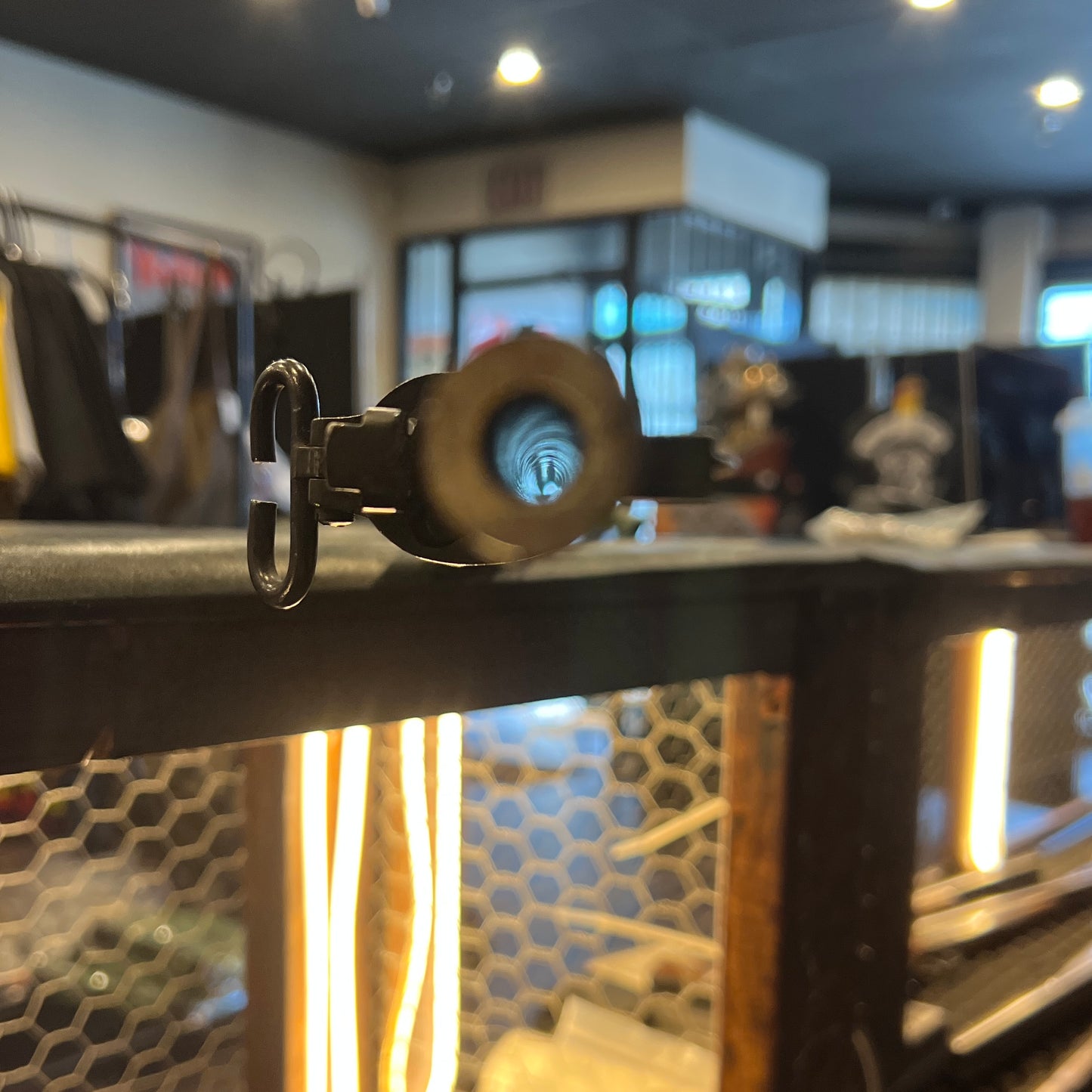
Most importantly, careful examination of the bore confirms seven-groove Metford-pattern rifling, rather than the five-groove Enfield rifling associated with the Magazine Lee-Enfield.
This is a significant identifying feature and is central to the proper interpretation of this rifle.
Historical Background
During the late nineteenth and early twentieth centuries, BSA manufactured Lee-action rifles not only for military purposes, but also for the British commercial and competitive shooting markets.
Some of these commercial rifles retained the appearance and equipment of contemporary military Long Lee rifles to a remarkable degree, while being intended for private ownership, target shooting, or competitive use.
This historical background is supported by surviving period rifles and important museum collections.
The Imperial War Museums collection includes BSA commercial Lee rifles manufactured in military service-rifle style, demonstrating that a commercially produced BSA Lee could closely resemble a military Magazine Lee-Enfield while belonging to a different commercial production tradition.
Of particular relevance, the National Army Museum collection records a circa-1896 Lee-Speed .303 target rifle fitted with special long-range target sights and retailed by G. Fulton.
The museum rifle is not presented here as proof that the present rifle is the identical model or configuration. It does, however, provide important historical comparison and confirms that commercial Lee rifles, specialized long-range target equipment, and G. Fulton were already directly associated within the British target-shooting world of this period.
The configuration of the present rifle is therefore entirely consistent with a well-established period tradition rather than representing an unexplained modern combination of components.
Exceptionally Complete Long Lee Configuration
One of the greatest strengths of this rifle is the remarkable completeness of its early Long Lee service-style configuration.
It retains:
- Full-length fore-end and upper handguard
- Complete volley sight system
- Magazine cut-off
- Early long-range ladder rear sight
- Front barrel band without a clearing-rod hole
- Stacking hook
- Period military-pattern bayonet mounting arrangement
- Brass buttplate with trap
- Detachable magazine
Many surviving military Long Lee rifles were subsequently converted into Charger Loading Lee-Enfield (CLLE) configuration, while others lost components such as volley sights, magazine cut-offs, handguards, and other early fittings through military refurbishment or later civilian use.
Finding a rifle that retains such a complete early Long Lee configuration is increasingly uncommon and represents one of this rifle’s strongest collector attributes.
Exceptional Woodwork
The woodwork is exceptionally well preserved.
The stock set remains remarkably clean, displaying only relatively light handling and age-related marks. Particularly noteworthy is the condition of the upper handguard, which remains extremely well preserved with crisp edges and an excellent overall appearance.
Its color, finish, and naturally aged patina correspond very closely with the fore-end and buttstock, giving the entire rifle an unusually uniform appearance with virtually no distracting color mismatch.
Upper handguards were among the components frequently damaged or replaced during military service, competitive use, and later refurbishment. The remarkably well-matched appearance of the furniture on this rifle is therefore particularly desirable from a collector’s standpoint.
Metalwork and Bore
The metalwork is likewise very well preserved, retaining an attractive period finish and naturally aged patina with normal handling wear and no significant external corrosion visible.
The bore is particularly impressive for a rifle of this age.
The rifling remains strong, clean, and clearly defined.
Most importantly, careful inspection confirms:
SEVEN-GROOVE METFORD-PATTERN RIFLING
The Metford system employed seven relatively shallow grooves with smooth, rounded transitions, distinctly different from the later five-groove Enfield rifling used in the Magazine Lee-Enfield.
The survival of a strong seven-groove Metford bore is therefore one of the most historically and mechanically significant features of this rifle.
G. FULTON Marking
Another particularly important collector feature is the clearly stamped:
G. FULTON
marking located on the barrel near the receiver, visible beneath the rear opening of the upper handguard.
G. Fulton was closely associated with Britain’s historic competitive rifle-shooting tradition and the famous Bisley ranges, becoming one of the best-known names connected with the preparation, regulation, servicing, and supply of Lee-series rifles for serious target shooting.
The historical significance of this association is reinforced by the National Army Museum, whose collection includes a circa-1896 Lee-Speed .303 target rifle equipped with special long-range target sights and documented as having been retailed by G. Fulton.
This museum-held example provides an especially interesting period comparison and confirms Fulton’s documented involvement with commercial Lee target rifles during the era.
The Fulton marking on the present rifle is stamped directly on the barrel rather than on an easily replaced minor component, providing a particularly interesting historical association between this rifle — or at minimum its barrel assembly — and the Fulton establishment.
Without surviving documentation specific to this individual rifle, no claim is made as to precisely what work Fulton performed or when that work was carried out. Nevertheless, the marking represents a genuine and highly desirable connection to the historic British target-rifle tradition.
“FOR CORDITE ONLY” and Other Markings
The barrel reinforce also retains the distinctive period marking:
FOR CORDITE ONLY
together with British commercial proof and inspection markings and the stamped number:
B0334
Comparable FOR CORDITE ONLY markings are documented on surviving period BSA commercial Lee rifles, including museum-held examples, making this marking entirely consistent with the rifle’s BSA commercial background.
A separate number:
23238
is visible on the action.
At present, sufficient original BSA factory documentation has not been located to establish conclusively the exact relationship between 23238 and B0334. The two numbers are therefore recorded separately and are not represented as matching serial numbers.
The original serial number on the bolt handle has unfortunately been removed, preventing confirmation that the bolt is serial matching to the action.
Internally, the bolt retains a small period inspection or assembly marking.
Overall Assessment
Taken together, the surviving physical evidence identifies this rifle most appropriately as an early BSA commercial Long Lee target/service-pattern rifle fitted with seven-groove Metford rifling, rather than simply as an ordinary five-groove military Magazine Lee-Enfield Mk I*.
Its collector appeal lies in an unusually compelling combination of features:
BSA commercial manufacture
Seven-groove Metford rifling
Exceptionally complete early Long Lee service-style configuration
Complete volley sight and magazine cut-off systems
Excellent surviving woodwork
Strong, well-preserved bore
Period “FOR CORDITE ONLY” marking
Desirable G. Fulton marking and British target-shooting association
Surviving period rifles and museum collections confirm that commercially produced BSA Lee rifles retaining military-style Long Lee configurations formed a genuine and important part of British rifle and competitive shooting culture during the late Victorian and early twentieth-century period.
The documented National Army Museum example associated with G. Fulton provides a particularly compelling historical comparison.
With its seven-groove Metford bore, exceptional completeness, excellent overall condition, and fascinating Fulton connection, this rifle represents a rare and highly attractive surviving example of the early British commercial Long Lee and target-rifle tradition.
Share